
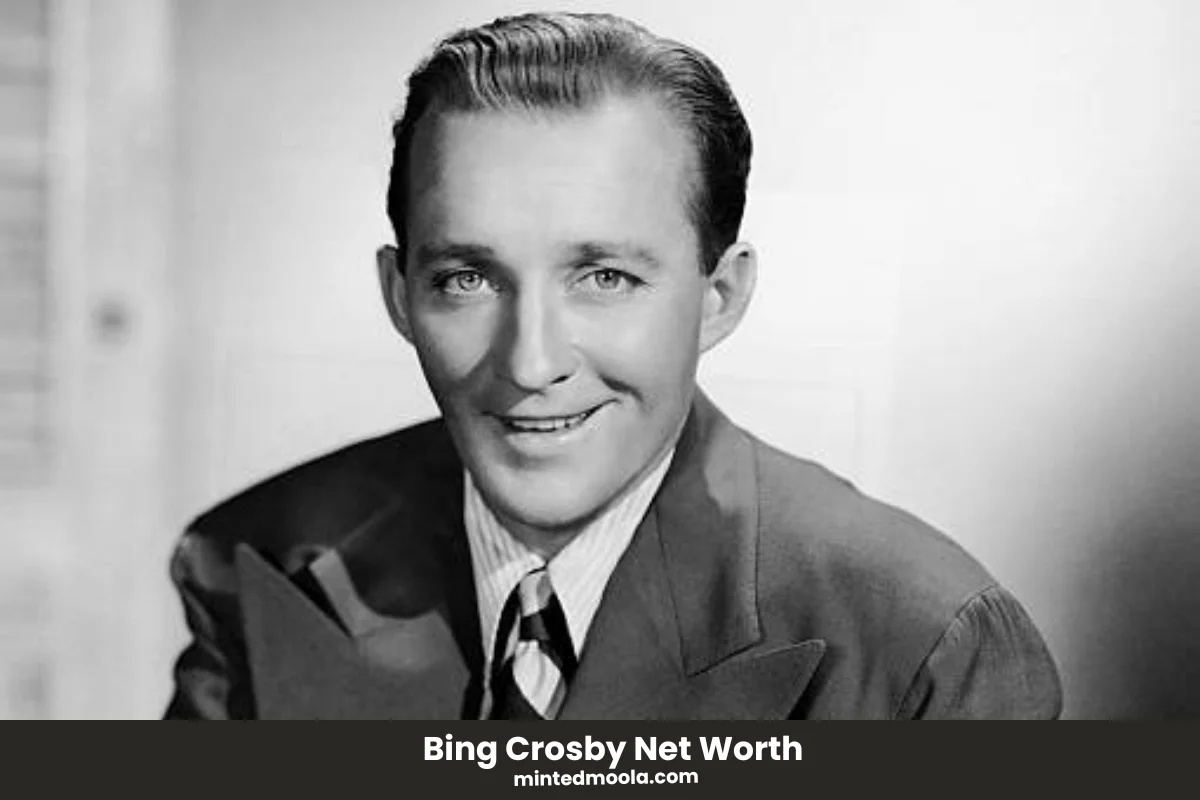
Bing Crosby’s net worth at the time of his death was approximately $50 million (equivalent to roughly $400 million in today’s dollars), accumulated through his multifaceted career as a singer, actor, businessman, and media personality.
Bing Crosby Net Worth: $50 million (Estimated)
His income streams included record sales exceeding 1 billion units worldwide, earnings from over 70 feature films, as well as radio and television shows, wise real estate investments, and strategic business ventures, including major stakes in the Pittsburgh Pirates baseball team and Minute Maid orange juice.
In this article, together we will examine his early life influences, groundbreaking career achievements across multiple platforms, complex family relationships, diverse income sources, business ventures, and lasting cultural legacy—all factors that contributed to his impressive financial success and enduring impact on American entertainment.
| Full Name | Harry Lillis Crosby Jr. |
| Gender | Male |
| Date of Birth | May 3, 1903 |
| Death | October 14, 1977 |
| Birthplace | Tacoma, Washington |
| Net Worth (Before Death) | $50 million (Estimated) |
| Profession | Singer, Comedian, Entertainer, Actor |
| Sources of Income | Album sales, Movie Salary, Radio Show Hosting, Tv Production, Business Venture |
| Age | 74 |
| Height | 5 feet 7 inches (1.70 meters) to 5 feet 7 ¾ inches (1.72 meters) tall |
| Nationality | American |
| Last Update | 31 Jan, 2026 |
3 Key Takeaways
- Bing Crosby’s net worth was estimated to be around $400 million before his death.
- Bing Crosby accumulated his net worth from his music and recording, film career income, radio and television show, and Business ventures, including Bing Crosby Productions.
- Bing Crosby received an Oscar in 1945 for his role as Father Chuck O’Malley in the film “Going My Way”.
- 3 Key Takeaways
- Who is Bing Crosby?
- How Much was Bing Crosby Net Worth?
- Early Life of Bing Crosby
- Bing Crosby’s Career and Its Contribution to His Net Worth
- Crosby’s Signature Style and Cultural Impact
- Bing Crosby Family and Role in His Net Worth
- What was the Cause of Bing Crosby Death?
- Bing Crosby Controversy and How its Impact on Career
Who is Bing Crosby?
Bing Crosby was an American singer, actor, and businessman who revolutionized popular entertainment across multiple platforms during the mid-20th century. His full and real name was Harry Lillis Crosby Jr., born on May 3, 1903, in Tacoma, Washington. The nickname “Bing” originated during his childhood from his fondness for a comic strip called “The Bingville Bugle.”
Crosby’s distinctive bass-baritone voice, relaxed delivery style, and innovative recording techniques transformed popular music. His 1942 recording of “White Christmas” remains the best-selling single of all time, with over 50 million copies sold globally. Beyond music, Crosby conquered film, radio, and television while pioneering media technology advancements that continue to influence entertainment today.
How Much was Bing Crosby Net Worth?
Bing Crosby accumulated a net worth of approximately $50 million at the time of his death in 1977, equivalent to roughly $400 million when adjusted for inflation. According to multiple entertainment historians and financial analysts, this substantial fortune established him as one of the wealthiest entertainers of his era.
Evidence of Crosby’s remarkable wealth appears throughout documented financial records, property holdings, and business investments. According to entertainment biographer Gary Giddins, Crosby consistently ranked among America’s highest taxpayers during the 1940s and 1950s, often paying over 90% in income taxes on his highest earnings.
Crosby’s wealth stemmed from diverse revenue streams, including:
- Music sales exceed 1 billion records, tapes, and digital units worldwide.
- Salaries and percentages from 70+ feature films, including Academy Award-winning performances.
- Radio and television program contracts spanning four decades.
- Real estate holdings across California, Nevada, and Washington.
- Business ventures include partial ownership of the Pittsburgh Pirates baseball team.
- Strategic investments in technological innovation, including tape recording development.
- Ownership stakes in oil wells, horse racing tracks, and television stations.
Crosby diversified his income sources well beyond entertainment, and this can be considered one of his strategies for financial growth and a long-term wealth-building plan.
Bing Crosby’s Sources of Income
The major sources of income that contributed to Bing’s net worth came from-
- Music and recording
- Film Career
- Radio and Television
- Business Venture
- Bing Crosby Production
Let’s get into the details of Bing Crosby’s income sources that contributed to his overall net worth in the following.
1. Music and Recording
Crosby’s recording career generated substantial revenue with over 1,600 songs recorded and album sales exceeding 1 billion units. His recording contract with Decca Records, signed in 1934, delivered unprecedented royalties for that era, with his signature song “White Christmas” alone generating millions in recurring revenue through reissues and licensing.
2. Film Career
Crosby commanded $100,000+ per film during his prime years at Paramount Pictures (equivalent to approximately $1.5 million today). His box office success consistently placed him among Hollywood’s top-earning performers between 1934-1954. Films like “Going My Way” and the “Road” series with Bob Hope generated significant percentage points of profits beyond his base salary.
3. Radio and Television
The “Kraft Music Hall” radio program paid Crosby $3,000 weekly (roughly $50,000 today) over its 10-year run. His pioneering pre-recorded radio shows revolutionized broadcasting while generating substantial advertising revenue. Television specials throughout the 1960s and 1970s commanded premium sponsorship rates.
4. Business Ventures
Crosby’s investment portfolio included substantial oil and gas properties, real estate developments, and manufacturing interests. His stake in Minute Maid orange juice, purchased for $100,000 in 1948 and later sold to Coca-Cola, multiplied into millions. Partial ownership of the Pittsburgh Pirates baseball team and several television stations generated consistent annual returns.
5. Bing Crosby Productions
Bing Crosby Productions (BCP) contributed approximately $25 million to Crosby’s overall net worth, according to entertainment industry analyses. He founded the company in 1951, and this independent production company represented one of Crosby’s most significant business ventures outside his performing career.
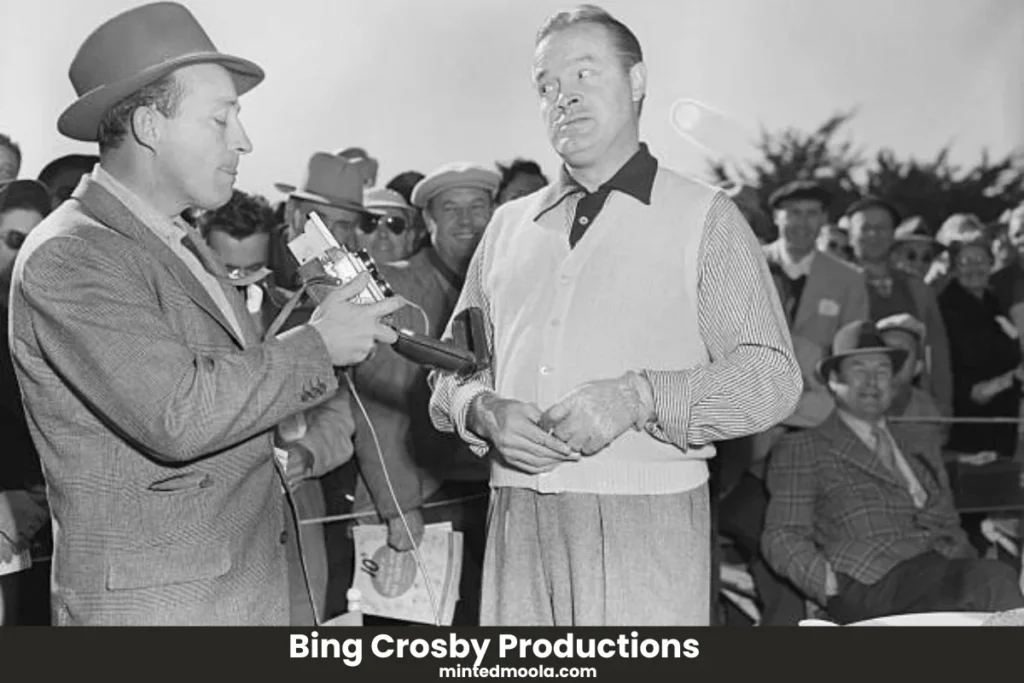
BCP produced successful television series, including “Hogan’s Heroes,” “Ben Casey,” and “The Judge,” each generating substantial syndication revenue. The company’s innovative approach to television production included pioneering videotape recording technology, giving BCP distinct competitive advantages in production efficiency and program distribution.
In 1967, Crosby sold BCP to Cox Broadcasting for $12 million (approximately $97 million in today’s dollars) while retaining profitable percentage points in ongoing program syndication.
Bing Crosby’s Net Worth at Death
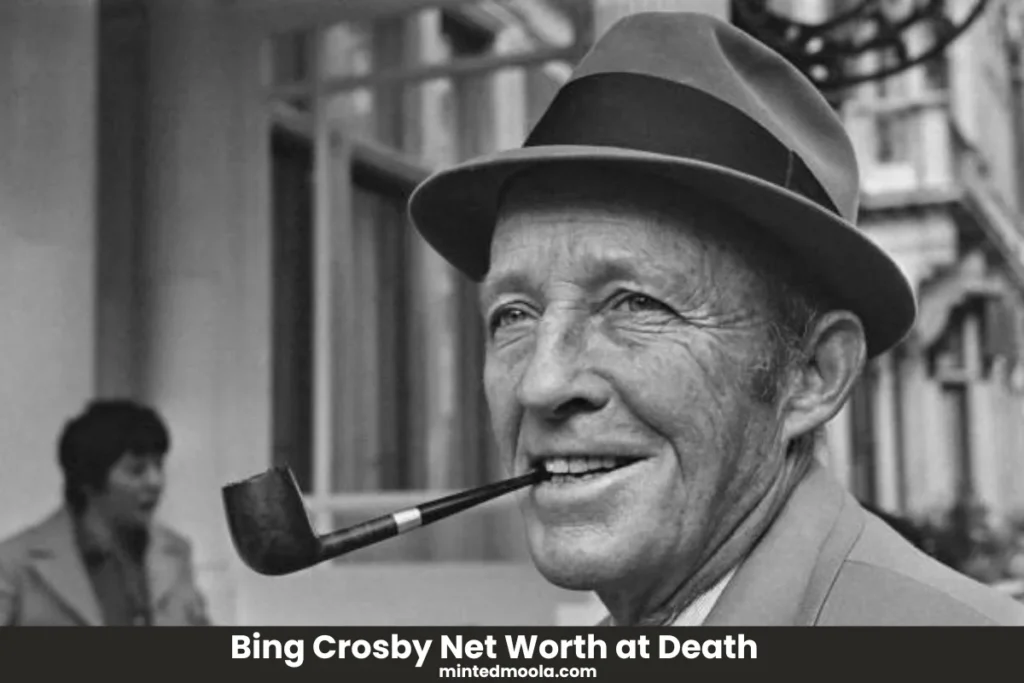
Bing Crosby’s estate was valued at $50 million ($400 million in today’s dollars) following his death on October 14, 1977. This substantial fortune made him one of the wealthiest entertainers in American history at that time.
Estate documents revealed remarkably diverse assets spanning multiple industries and investment categories. Crosby’s financial portfolio included substantial real estate holdings throughout California, including his 8,000-acre ranch near Elko, Nevada, valued at $7.5 million in 1977. His collection of rare wines, valued at over $2 million, represented one of the most valuable private collections in America.
Additional wealth sources included significant stock portfolios, ongoing music and film royalties, and partial ownership in multiple businesses.
His estate planning demonstrated considerable financial foresight, establishing trusts and investment structures that continued generating wealth for his heirs long after his death.
Early Life of Bing Crosby
Bing Crosby emerged from modest beginnings as the fourth of seven children in a working-class Catholic family in Tacoma, Washington. His father, Harry Lowe Crosby, worked as a bookkeeper, while his mother, Catherine Helen Harrigan, devoted herself to raising their large family. The household valued music, with regular family singing sessions around their piano shaping young Bing’s musical sensibilities.
Financial challenges forced Crosby to develop resourcefulness early in life. He delivered newspapers, worked odd jobs, and developed entrepreneurial instincts that would later inform his business ventures.
His education at Gonzaga High School and later Gonzaga University provided an academic foundation, though he never completed his law degree, choosing instead to pursue entertainment.
Crosby’s personality developed through formative experiences, including performing in school productions, joining local singing groups, and absorbing diverse musical influences from classical to jazz.
His early exposure to vaudeville and emerging recording technology sparked his interest in entertainment innovation.
These foundational experiences instilled disciplined work ethics, technological curiosity, and financial pragmatism that directly contributed to his later wealth accumulation strategies.
Bing Crosby’s Career and Its Contribution to His Net Worth
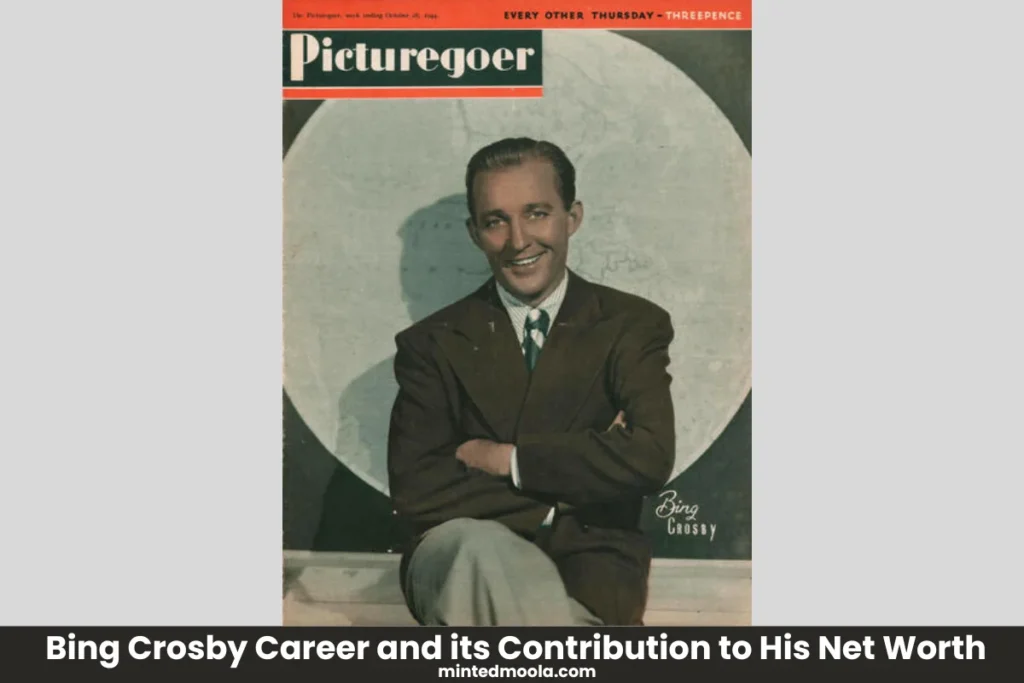
Bing Crosby built his extraordinary fortune through unprecedented multi-platform success across the recording, film, radio, and television industries spanning five decades.
His career trajectory revolutionized entertainment while generating diverse revenue streams that created his substantial wealth.
Beginning in 1926 with the Paul Whiteman Orchestra, Crosby quickly established himself through innovative vocal techniques and technological embracement.
His strategic career decisions included pioneering record production methods, developing radio program formats, and creating lucrative business models for celebrity endorsements.
Financially, Crosby’s savvy extended beyond performing. He negotiated groundbreaking contracts guaranteeing ownership percentages in his productions, established tax-advantaged corporate structures, and invested performing earnings into diverse business ventures.
His innovations in broadcasting contracts, particularly securing rights to record radio programs rather than performing live, created entirely new revenue models for entertainers.
Unlike many contemporaries who focused solely on immediate earnings, Crosby consistently reinvested profits into businesses, properties, and technologies, yielding long-term returns.
Bing Crosby Filmography
Bing Crosby appeared in 79 feature films spanning four decades, with combined box office receipts exceeding $600 million (unadjusted). His film career began with early musical shorts in 1930, transitioning to starring roles that consistently ranked among Hollywood’s highest-grossing productions.
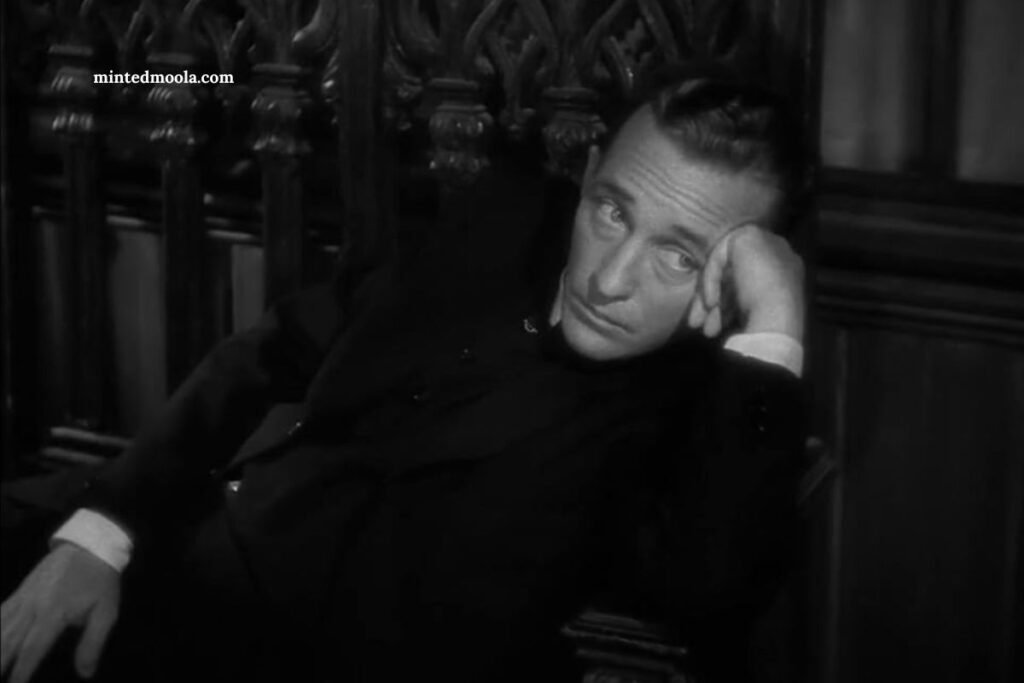
Crosby’s seven “Road” films with Bob Hope generated exceptional profits, with “Road to Morocco” (1942) earning $4 million against a $1 million production budget.
His dramatic performances earned critical acclaim, with “Going My Way” (1944) becoming Paramount’s highest-grossing film to that date. Films like “White Christmas” (1954) continued generating substantial revenue through theatrical re-releases and television licensing for decades.
Financially, Crosby pioneered innovative film contracts including:
- Securing percentage points of film profits rather than flat salaries
- Retaining partial ownership rights to musical performances
- Negotiating merchandising and licensing revenues
- Establishing approval over film distribution decisions
These innovative business approaches transformed his film appearances into significant wealth-generating assets that continued producing income long after production completed.
Bing Crosby Oscar and Grammy Awards
Bing Crosby won the Academy Award for Best Actor for his portrayal of Father Chuck O’Malley in “Going My Way” (1944). This achievement established him as the first popular music performer to receive acting’s highest honor.
Crosby’s Oscar-winning performance delivered significant financial benefits beyond the prestigious recognition. His salary for subsequent films immediately doubled to approximately $150,000 per picture (equivalent to $2.5 million today). “Going My Way” grossed over $6.5 million domestically, generating substantial percentage points for Crosby beyond his base compensation.
The Oscar significantly enhanced Crosby’s international marketability. Previously popular primarily in English-speaking countries, post-Oscar films received wider global distribution, particularly in European and South American markets. This expanded audience directly increased both film revenues and related music sales.
Crosby received two additional Best Actor nominations for “The Bells of St. Mary’s” (1945) and “The Country Girl” (1954), further solidifying his status as a serious dramatic actor commanding premium compensation beyond his musical reputation.
Bing Crosby also won another prestigious Grammy award in 1963. The actor also won many more awards, you can the full list here.
Bing Crosby Discography
Bing Crosby recorded approximately 1,600 songs between 1926 and 1977, creating one of popular music’s most extensive catalogs. His recordings achieved unprecedented commercial success with total sales exceeding 1 billion units worldwide—a record unmatched for decades.
Crosby pioneered recording techniques including microphone utilization, vocal overdubbing, and master recording preservation that revolutionized the music industry. His contract with Decca Records provided industry-leading royalty rates of 15% compared to the standard 5% offered to most contemporaries.
His music catalog includes 41 #1 hit singles and 23 gold and platinum albums. His recording of “White Christmas” has sold over 50 million copies, recognized by Guinness World Records as the best-selling single of all time.
The consistent annual re-releases of his Christmas recordings created perpetual revenue streams continuing decades after their initial release.
Bing Crosby Movies List
Bing Crosby’s greatest hits include “White Christmas” which sold over 50 million copies and remains the best-selling single worldwide. “Silent Night” ranks second with estimated sales exceeding 30 million copies. “Swinging on a Star” earned both commercial success and the Academy Award for Best Original Song.
Other notable Crosby songs include:
- “Don’t Fence Me In”
- “Pennies From Heaven”
- “It’s Been a Long, Long Time”
- “Sunday, Monday, or Always”
- “Too-Ra-Loo-Ra-Loo-Ral”
- “Accentuate the Positive”
- “You Are My Sunshine”
- “Deep in the Heart of Texas”
“White Christmas” transformed holiday music marketing, creating the concept of seasonal recordings as annual revenue generators. Recorded in just 18 minutes as part of the film “Holiday Inn,” it became a perennial bestseller, reissued annually for 30+ consecutive years.
Its nostalgic wartime associations with American servicemembers created emotional connections transcending typical popular music.
“Silent Night” showcased Crosby’s reverent vocal approach, displaying technical mastery through controlled dynamics and impeccable breath control.
“Swinging on a Star” demonstrated his versatility beyond ballads with its playful educational lyrics and sophisticated musical arrangement.
Crosby’s Signature Style and Cultural Impact
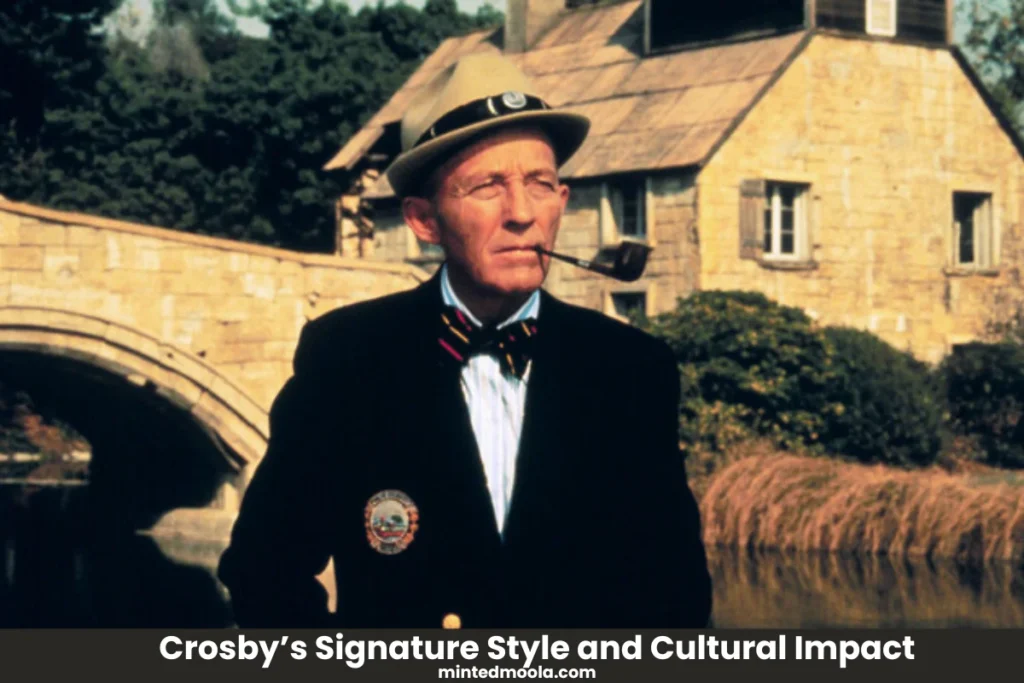
Crosby’s casual style – characterized by cardigans, pipes, and golf attire – influenced 1940s and 1950s American male fashion. His laid-back demeanor contrasted sharply with the more formal entertainers of previous generations.
His distinctive vocal technique utilized microphone technology more effectively than previous singers. Crosby’s relaxed “crooning” style influenced generations of vocalists including Frank Sinatra, Dean Martin, and Elvis Presley.
Crosby appeared on 4,000+ radio broadcasts and sold hundreds of millions of records. His song “White Christmas” holds the Guinness World Record for best-selling single, and he recorded 41 #1 hit singles during his career.
Bing Crosby Family and Role in His Net Worth
Bing Crosby established two distinct family units through his marriages, with seven children total and numerous noteworthy descendants. His family dynamics significantly influenced both his public persona and financial decisions throughout his career.
The Crosby family tree begins with his parents, Harry Lowe Crosby (bookkeeper) and Catherine Helen Harrigan (homemaker). Bing grew up with six siblings: brothers Larry (became entertainment lawyer), Everett (managed Bing’s business affairs), Ted (worked in advertising), and Bob (became bandleader), and sisters Catherine and Mary Rose.
Bing’s siblings played crucial roles in his career development. Larry negotiated numerous contracts, while Everett managed financial investments. This family-centered business approach created trust but sometimes generated tensions regarding financial control and decision-making authority.
Crosby’s parents instilled Catholic values and disciplined work ethics that influenced his approach to wealth. Their working-class background shaped his financial conservatism and preference for stable investments over high-risk ventures despite his substantial resources.
Who Was Bing Crosby Married To?
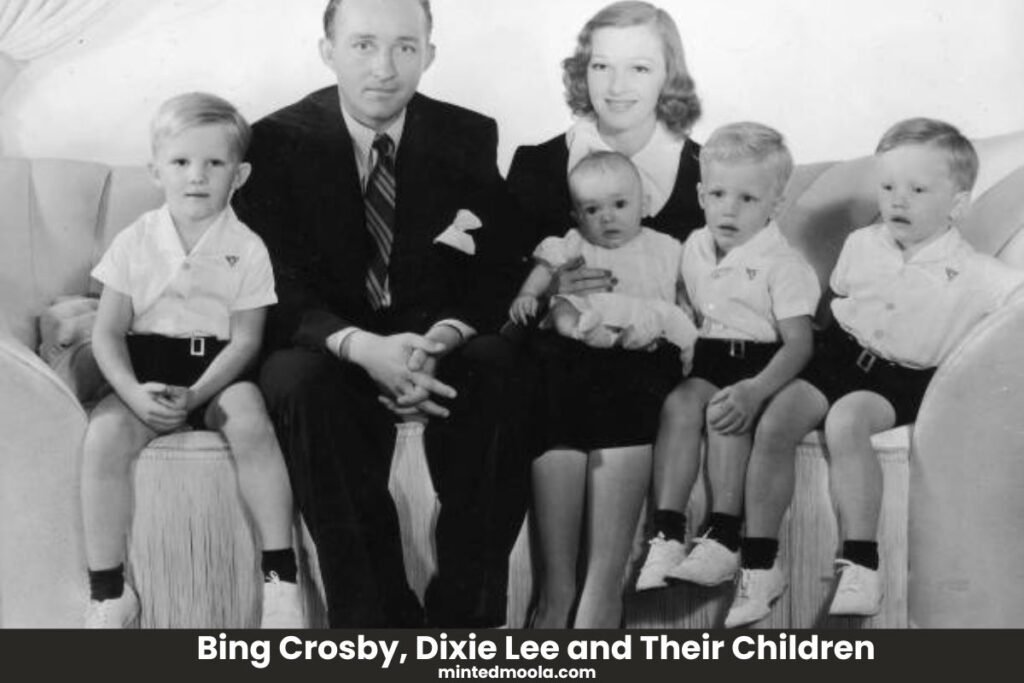
Bing Crosby married actress/singer Dixie Lee in 1930 as his first wife, remaining together until her death from cancer in 1952. Their relationship endured despite his demanding career and her struggles with alcoholism. Seven years after Dixie’s death, Crosby married actress Kathryn Crosby after their marriage in 1957, though she maintained her own acting career while raising their young family.
The 30-year age difference between Bing and Kathryn (he was 54, she was 23 when they married) generated substantial public attention. Their marriage lasted 20 years until his death in 1977, with Kathryn balancing family responsibilities with occasional film and television appearances.
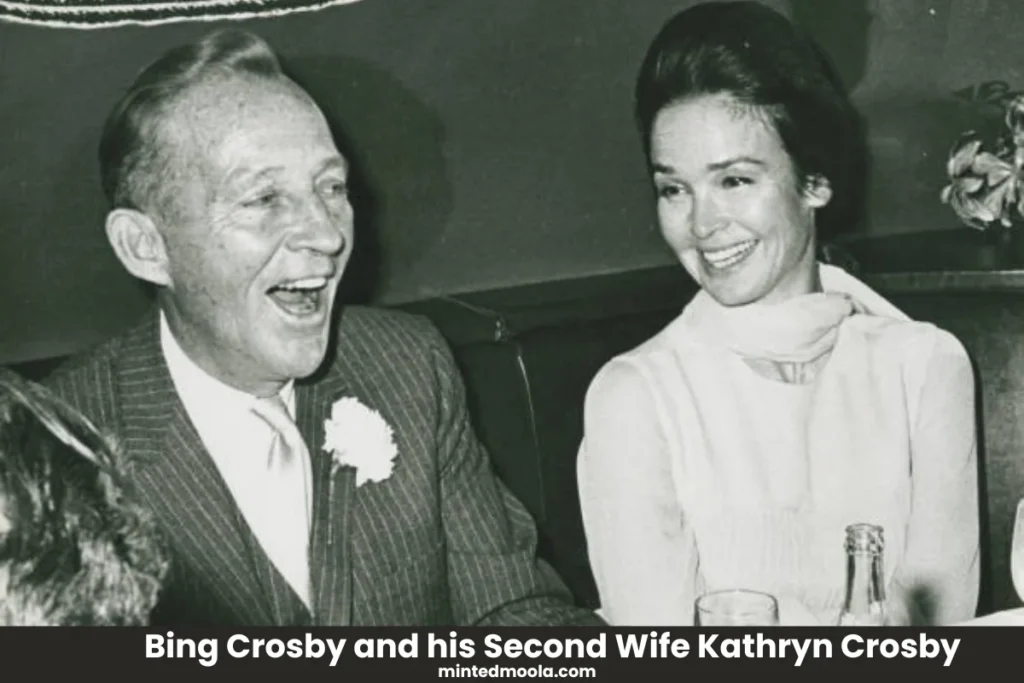
Kathryn played significant roles in managing Crosby’s later career, including overseeing his television specials and public appearances.
She actively participated in philanthropic endeavors including the establishment of the Bing Crosby Youth Fund, which financed numerous educational initiatives.
Bing Crosby Childrens
Bing Crosby had seven children from his two marriages.
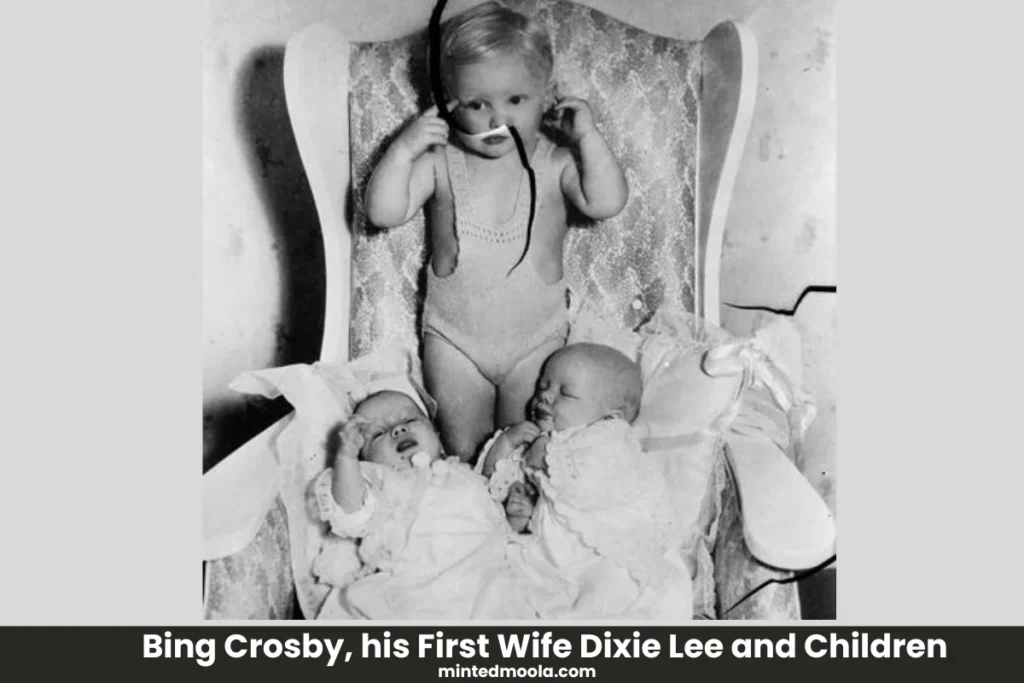
With his first wife, Dixie Lee:
- Gary Crosby (1933-1995) – Singer and actor.
- Dennis Crosby (1934-1991) – Singer. Twin brother of Phillip.
- Phillip Crosby (1934-2004) – Singer and actor. Twin brother of Dennis.
- Lindsay Crosby (1938-1989) – Singer and actor.
These four sons often performed together as a singing group called “The Crosby Boys”.
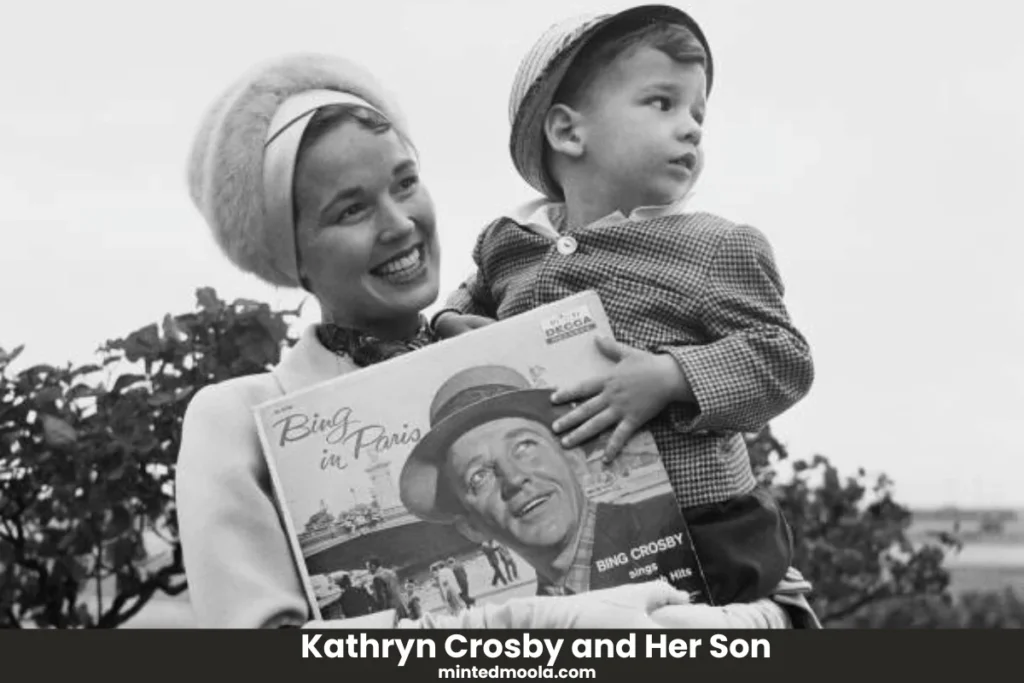
With his second wife, Kathryn Grant:
- Harry Crosby (born 1958) – Investment banker.
- Mary Crosby (born 1959) – Actress, best known for her role in the television series “Dallas”.
- Nathaniel Crosby (born 1961) – Professional golfer.
Bing Crosby had two daughters: Mary Crosby from his second marriage and Lindsay Crosby (adopted) from his first marriage.
Crosby’s parenting approach changed dramatically between his first and second families. His daughter Mary described him as “a totally different father the second time around.” With Mary, born when he was 56, Crosby demonstrated greater patience, emotional availability, and consistent presence compared to his parenting of his first family.
How Tall Was Bing Crosby?
Bing Crosby stood 5 feet 7 inches (170 cm) tall, slightly below the average American male height of his era. His moderate stature influenced his on-screen pairings, camera techniques, and personal style choices throughout his career.
What was the Cause of Bing Crosby Death?
Bing Crosby died from a massive heart attack on October 14, 1977, after completing a round of golf at La Moraleja Golf Course near Madrid, Spain. The 74-year-old entertainer collapsed on the clubhouse steps after playing 18 holes with Spanish professional golfers.
Crosby’s death occurred during a working vacation combining his passions for golf and entertainment. He had just completed filming his annual Christmas television special in England days earlier and was scheduled to record voice tracks for a new album the following week.
Despite previous health concerns including a back injury requiring surgery in 1973, Crosby’s death was unexpected. His final words reportedly were “That was a great game of golf, fellas” spoken to his playing partners just moments before his collapse.
I have not found any rumors or mysteries surrounding Crosby’s death. Medical authorities confirmed the cause as acute heart failure without any suspicious circumstances. Spanish medical officials completed standard examinations before releasing his body for return to the United States.
Bing Crosby Funeral
Bing Crosby is buried at Holy Cross Cemetery in Culver City, California, following funeral services held at St. Paul the Apostle Catholic Church in Los Angeles on October 19, 1977. The private service limited to family and close friends contrasted with the massive public response to his passing.
The cemetery, established in 1939, contains numerous entertainment industry figures including Rita Hayworth, John Candy, and Sharon Tate. Crosby’s grave marker features a simple design with his birth name, Harry Lillis Crosby, rather than his professional moniker.
Did Bing Crosby’s Wife Remarry?
Kathryn Crosby remarried in 2010, 33 years after Bing’s death, to businessman Maurice William Sullivan. The marriage ended tragically less than a month later when Sullivan died from injuries sustained in a car accident that also seriously injured Kathryn.
Prior to this brief second marriage, Kathryn remained actively involved in preserving Crosby’s legacy through numerous projects. She published her memoir “My Life with Bing” in 1983, participated in documentaries about his career, and maintained the Crosby name professionally as “Kathryn Crosby” throughout her post-Bing career.
Who Inherited Bing Crosby’s Estate?
Bing Crosby’s estate was divided among his widow Kathryn and his seven children through carefully structured trusts established years before his death. His will, filed in Los Angeles County on November 8, 1977, revealed sophisticated estate planning designed to minimize tax implications.
The distribution allocated specific percentages rather than fixed dollar amounts, providing ongoing shares of continuing royalties, business interests, and investment returns. Kathryn received approximately 40% of the estate including their primary residence and personal possessions.
Each of his seven children received trusts representing approximately 10% of the estate value, with specific distribution schedules varying based on their ages and circumstances. The estate administration continued for several years due to its complexity, with final settlement occurring in 1983.
Notably, Crosby established separate management structures for his intellectual property rights, ensuring long-term professional oversight of his recording masters, film rights, and licensing opportunities.
What Happened to Bing Crosby’s Children?
Bing Crosby’s children experienced dramatically different outcomes following his death, with his sons from his first marriage facing significant challenges while his second family generally thrived.
Tragically, three of Crosby’s sons from his first marriage—Lindsay, Dennis, and Gary—died by suicide in separate incidents (1989, 1991, and 1995 respectively). Each struggled with alcoholism and financial difficulties despite receiving substantial inheritances. Their fourth son, Phillip, maintained a lower profile while working as an actor and businessman.
In contrast, Crosby’s three children with Kathryn—Harry, Mary, and Nathaniel—established more stable lives and careers. Mary achieved acting success on television, Harry worked as an investment banker, and Nathaniel pursued golf and business ventures.
The stark contrast between outcomes for children from his first and second marriages became the subject of much speculation regarding Crosby’s parenting approach, though economic and social circumstances differed significantly between the two family units.
Bing Crosby Controversy and How its Impact on Career
Bing Crosby’s image faced significant reassessment following the 1983 publication of son Gary’s memoir “Going My Own Way,” which detailed allegations of physical and emotional abuse. These claims substantially complicated public perception of the beloved entertainer.
Gary Crosby described regular “Tuesday night beatings” and excessive disciplinary measures that contrasted sharply with Crosby’s public persona as a relaxed, genial performer. Several of Crosby’s children from his first marriage subsequently confirmed aspects of Gary’s account, while others disputed specific details.
Entertainment historians note that Crosby’s parenting reflected common disciplinary approaches of the 1940s-1950s rather than contemporary standards. His second wife Kathryn and children from that marriage consistently described a dramatically different father figure, suggesting his parenting approach evolved significantly over time.
These controversies generated minimal impact on Crosby’s financial legacy and career despite affecting his posthumous reputation. Record sales, film licensing, and other revenue sources continued largely unaffected by the revelations.
Did Bing Crosby Serve in the Military?
Bing Crosby did not serve in the military during either World War I or World War II despite being of eligible age during both conflicts. His absence from military service resulted from medical disqualification rather than deliberate avoidance.
Crosby received a 4-F classification (unfit for service) during his WWII draft evaluation due to a perforated eardrum sustained during childhood. This medical condition prevented his enlistment despite his expressed willingness to serve.
Despite his non-military status, Crosby contributed significantly to the war effort through:
- Performing on 300+ USO shows for troops overseas
- Recording special V-Disc records distributed exclusively to military personnel
- Participating in war bond drives raising over $14 million for military funding
- Broadcasting radio programs designed specifically for military morale
Military historians acknowledge Crosby’s substantial contributions to troop morale during WWII. General Dwight D. Eisenhower reportedly commented that Crosby’s “White Christmas” recording did more for soldier morale than any other single piece of entertainment.
Bing Crosby Last Photo
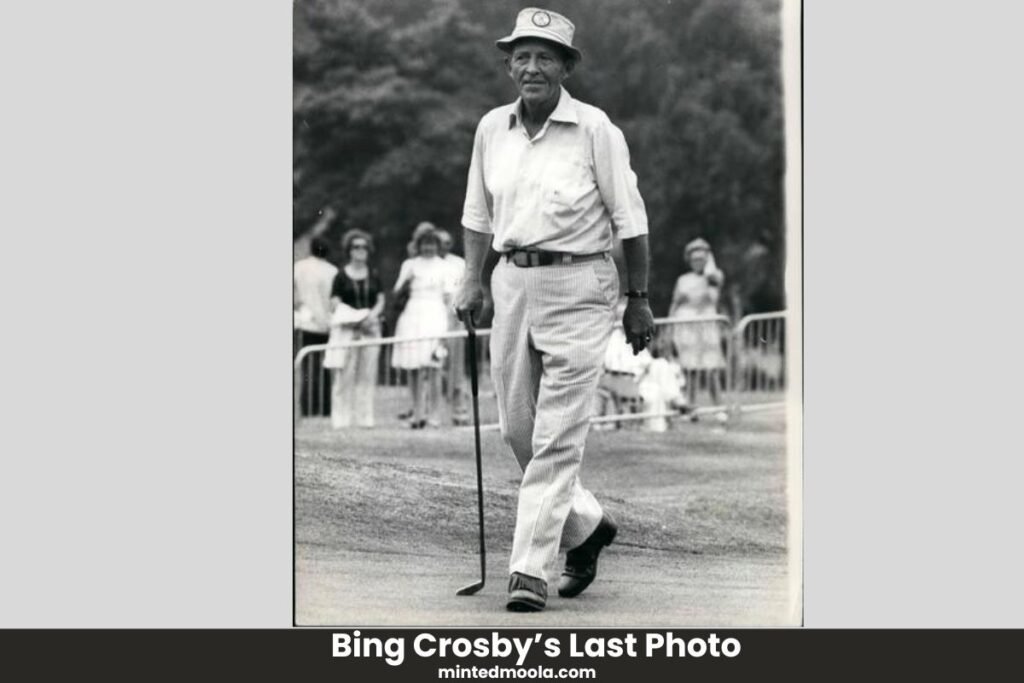
Bing Crosby’s last photos were taken on the golf course in Spain just hours before his death on October 14, 1977. These images show him smiling in golfing attire after completing what would be his final round of golf at La Moraleja Golf Course near Madrid.
Bing Crosby Quotes on Wealth and Money
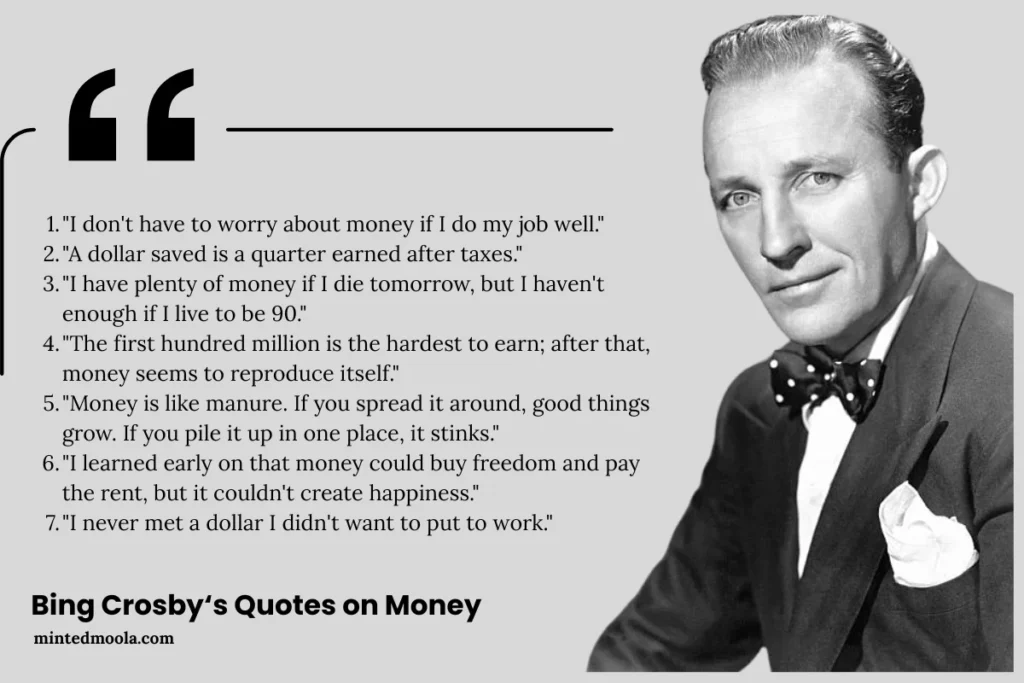
Bing Crosby maintained practical perspectives on wealth throughout his life despite his extraordinary financial success. Here are some of his quote on wealth and money-
- “I don’t have to worry about money if I do my job well.”
- “A dollar saved is a quarter earned after taxes.”
- “I have plenty of money if I die tomorrow, but I haven’t enough if I live to be 90.”
- “The first hundred million is the hardest to earn; after that, money seems to reproduce itself.”
- “Money is like manure. If you spread it around, good things grow. If you pile it up in one place, it stinks.”
- “I learned early on that money could buy freedom and pay the rent, but it couldn’t create happiness.”
- “The biggest waste of money is paying too much income tax.”
- “I never met a dollar I didn’t want to put to work.”
